Just after I received word about my layoff, a friend sent me a note: “It’s not your fault.” I’m sure it was meant with a big heart. It reminded me of the climactic scene in Good Will Hunting. For a second it felt good to have the support. But you know what? It absolutely IS my fault.
When the company decided to eliminate certain roles, roughly 1000 in total, I was on the chopping block for a reason. Not all “Squad Leaders” were eliminated. No, I’m sure some nugget of logic weighed a bunch of factors and found me along with some peers and deduced that we were expendable. I put myself in that position. I’ll do a full post-mortem of my career at Fido at some point, similar to what I did with TheMissionZone, but I wanted to share this observational post now.
The TechStars mantra for evaluating a company is “Team Team Team Market Progress Idea” in that order. The team is critical to the success of an initiative. I focused on my team, focusing and empowering them to deliver a good product. My job was to create a roadmap, build, and sell the product. Get our name out there and deliver value for our customers. I was doing product management. Which ironically is what we were supposed to be doing. We were executing the Spotify agile model. “…a people-driven approach to scaling Agile, emphasizing team autonomy, culture, and networked collaboration.”
As a leader, I think back on one of my favorite ski buddies and a single piece of wisdom he gave me 22 years ago. He was about to deploy to Iraq and just had a baby daughter a few months before. That was a rough time in Iraq and I honestly didn’t know what to say. I think I said something like “stay safe and keep your head down” which is complete BS but I said it anyway. Without blinking my friend said, “Fuck that. We’re the US Army, we lead from the front.” His voice imparted a ‘no shit’ kind of tone that formed the basis of my leadership mentality. I always want to be with my team in the proverbial trenches. Seeing what they see, experiencing what they live. A few years ago when my team was being bullied by another group whose leader outranked me, I passionately (read: colorfully) stood up for them. I paid the price, directly and monetarily. I’m calling this ‘managing down’ though I don’t mean that to sound pejorative.
My reflexions have brought me to the conclusion that I 100% absolutely SUCK at managing up. I mistakenly believed that if my manager knew the value we delivered, clearly I must be valuable. The master data structures we built are foundational to solid analytics. AI inferences are enabled by our standardized high-quality data. We did that. But my contributions to the success of the product and the company were not what he really valued. If I had demonstrated 30% team efficiency gains leveraging CoPilot dev-assist and produced slides on how we did that, I’d still have a job. We were doing that stuff, but I sold the product and value, not my ability to document cost savings while delivering. I needed to be smarter and ‘hear’ what was really important.
My problem is that even if I had realized this, I still believe in team and product over me. We were never “Josh’s team” or our playful moniker of “The Magicians.” I branded us as Enterprise Dimensions, because that’s what we did. But my lack of success is geared around the realization that I needed to manage up, know what my boss wanted and not supplant that with team/product success. That is my fault.
Pro Tip – If your company refers to “so and so’s team” rather than what they do: Manage up. It’s about the person rather than the product. A person can sell value, even if it is superfluous value. Aka selling sand in the desert. Some people are better at sales than others.
I also suck at sales. But that is another story. Some final conclusions for readers to use in evaluating their own situation:
- If you want to get ahead, be mindful of how you lead. Is it smarter to be Team first or Boss first?
- Understand what kind of boss you have. Are they looking to see and understand how you are succeeding, which demonstrates their success, or are you directly contributing to their success metrics? It should not be mutually exclusive, but watch out when in reality your goals consist only of their goals.
- Determine what kind of boss you are comfortable operating under.
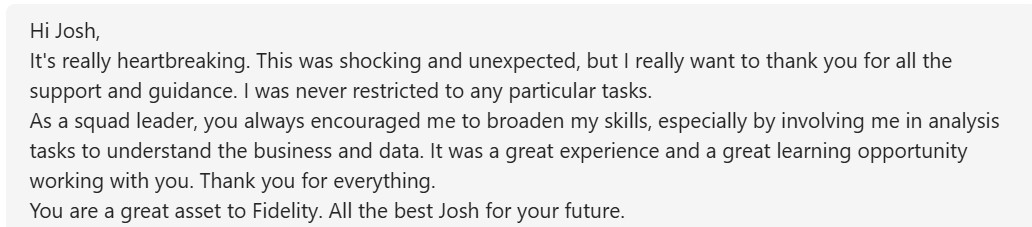
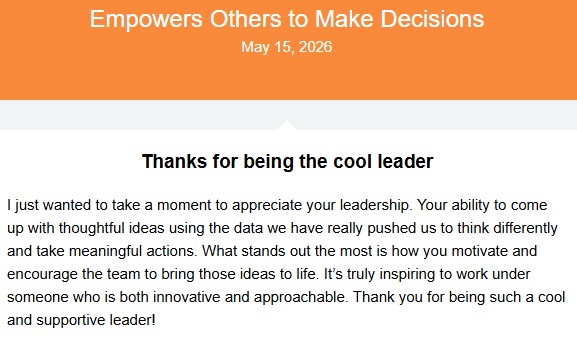
- Be true to the leader you want to be. When I left Fido, I got some really heartfelt notes from the team [see slider below]. A former team member from 3 years ago booked time to tell me how much she valued me. A member of the team appreciated how I would “scold” him for working late in the night.
Team Team Team. That’s the way I lead. It’s my fault I failed to manage up.