
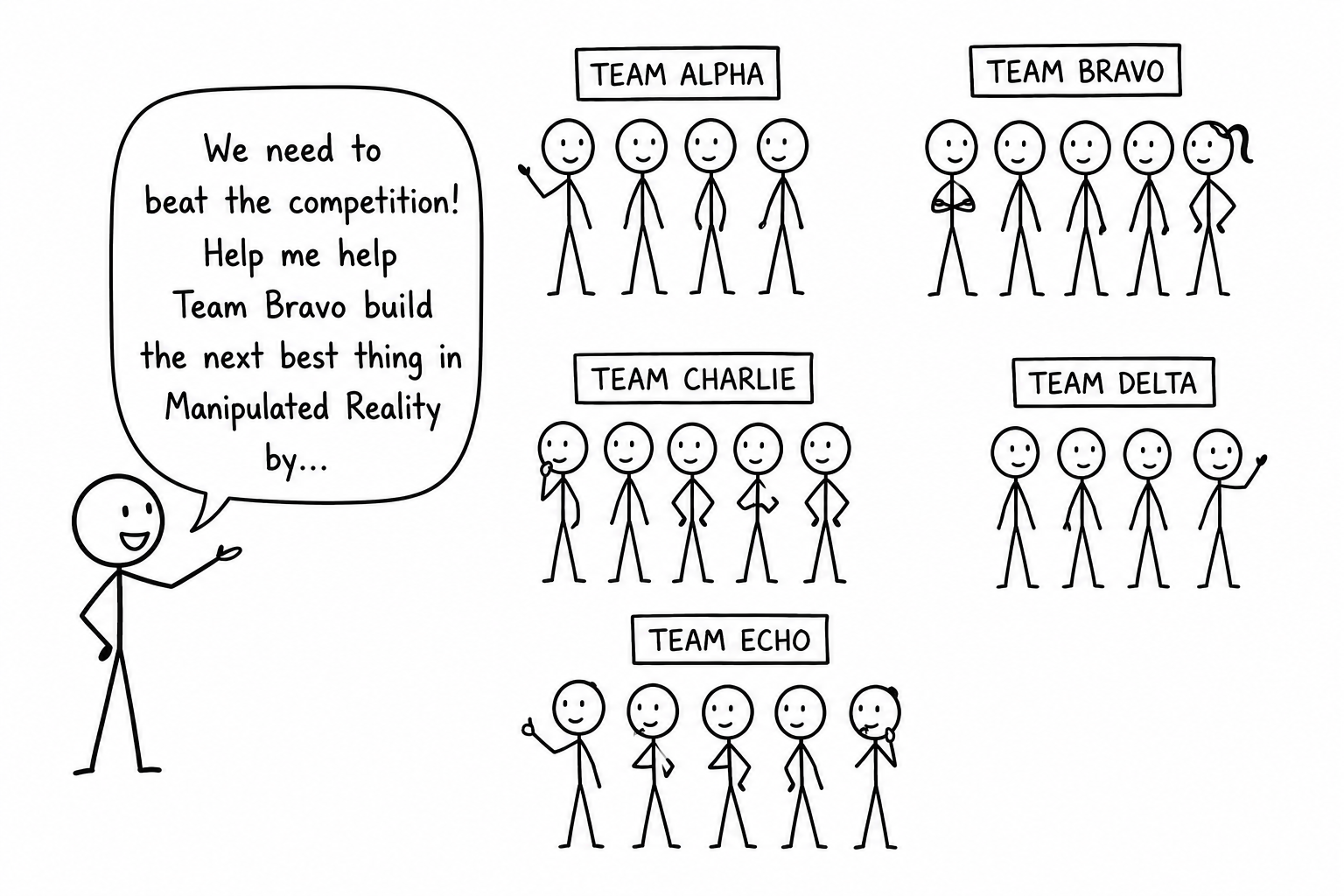
Managing a project or program at a large company requires the coordination of multiple teams across business units throughout the firm. The official term is to refer to this as a “matrix organization.” People don’t have to report to multiple managers directly. Often a company is so complex that “dotted line” reporting relationships exist in a spaghetti org chart. Getting things done in these situations is difficult as each team has its own set of goals and objectives, often set at the beginning of a performance year. A new initiative or tactical effort that requires multiple teams for success, isn’t on anyone’s personal goals. Are you going to stick your neck out and help some other team if it is not directly tied to your success (read: bonus)?
Usually these tactical initiatives can have a big benefit to the company and arise out of a security incident, market change, or response to a competitor’s product. They stem from a senior leader seeing something as important and then work with their direct reports to make it happen. It is important, but maybe not strategic. So executing across disparate teams is challenging. It’s most challenging at the individual team level when tasked from above, especially when peer groups don’t have the same directive.
It would be cool to schedule a kickoff meeting and have that sponsoring senior leader talk to all the potentially required teams directly. Then everyone’s boss could see it’s important. Maybe even add it to their goals. But even getting this coordination is tough. No one really knows early on, who they need and what each group will contribute until you start talking to teams. But teams don’t respond without knowing why they should. Hello catch-22.
Maybe that senior leader mentions it down the chain and it gets to you. You reach out to other teams and name drop the leader in the hopes of getting some cooperation. But this rarely works. Who hasn’t dropped a name in an email or meeting invite and heard crickets?
I’ve found that name dropping rarely works. Big meetings are impossible. Herding cats is never going to get something done quickly. So I was thinking of a new way of approaching the problem. What if you could ask your sponsoring senior leader to name drop you and your team as being important to their goals. I call it, “Reverse Name Dropping.”
Imagine a leader does their monthly address to the company, recorded video message or even a company wide email. They have a tactical initiative that is important and they name drop you to the whole company. A communication would look something like:
To: All associates.
From: Corporate CMO.
As you may know one of our main competitors has created a new xxx. I have asked Josh and his yyy team to pull together groups across our Tech organization to build a competitive offering within the next 3 months. Please make every effort to help his team complete this work. Come the end of year, all teams that have helped out, I will reach out personally to your leadership to make sure they know you were critical to the company’s success…
Leveraged Communication Channels:
- Email – A team could forward or reply to a peer if they already got it. “Hey, did you see this? Hoping you can help us out…”
- Recorded Video – Send a note attaching a link. “Darlene, did you get to see this video from our CMO? Hoping you can help us all look good by…”
- All Hands Meeting – After the meeting you reach out to a person in the room, “Can we talk about that new tactical solution our CMO just mentioned…”
I never really got to try this at Fido. I always wanted to create some slides and pitch it as a new way of working. It doesn’t solve the problem of misaligned objectives or the inability of companies to pivot quickly or (my soapbox) the incorrect structure of bonus incentives tied to goals that were created months ago. But I wonder if it could be a valid workaround to those larger structural problems and still deliver value by a single person putting in small effort to have big impact.


