Signs of Stupidity


It’s 8:30 AM, people are just getting to work. The parking lot fills from left (near the building) to the right. There are multiple lots with several rows of opposing-car spaces each. Quick, what is SERIOUSLY wrong here?

[Hint: 4 of these 5 people are complete morons]

Why would you NOT pull through to the space in front of the car to make it easier when you leave so you can pull straight out???

1) It helps your car. Why park facing in when it just means you have to shift unnecessarily into reverse before selecting drive. That extra shift is useless wear and tear. If you do this every day, you double the shifts on your transmission. That cuts in half the life of your transmission’s shift-life estimate. 

2) It saves gas. Ok even if you don’t care about the environment and burning fossil fuels you must care about money. Moving a car in one direction, stopping, and then moving in the other is a spectacular waste of kinetic energy. Unless you are the Flinstones, the only way you make that energy is by burning gas. 

3) It saves time. Shifting into reverse. Turning your head and body around. Checking both directions. Moving. Stopping. Shifting into drive. Looking around. Moving. That just wastes time. Probably 20 seconds. Is that a lot?  No but it is free time. 

I am so sick of waste. The notion that “I can’t be bothered” is a metaphor for American entitlement and laziness that will kill this country.  If I am a third would country looking to tackle the world leader, I’m fixing all this little stuff.  Execute flawlessly.  We are flawed. 

If this kind of crap throughout the day wastes 25 bps or one quarter of one percent of total economic output, on US GDP which is right about $20 trillion…that means we waste $50 billion dollars a year. Imagine that kind of macroeconomic savings from doing nothing but reflecting the fact that you are human and are supposed to be intelligent. 

This shit makes me insane. Don’t Be Dumb. 

#DBD

Posted in Uncategorized | Leave a comment

Jail House Rock

mob

Americans are 5% of the world population, but 24% of the world’s incarcerated populace is here in the US. Everyone says this is a problem. They argue we have too many people in jails. I agree that there are people in jail for the wrong reasons, like minor drug offenses. And I agree that sentencing guidelines have become arcane. Most importantly, I think the criminal justice system targets certain groups of people unfairly and needs reform.  But I would argue that our high incarceration rates are generally a reflection of something positive.

  • A society advances when it has a strong economy.
  • A strong economy creates demand.
  • Demand creates jobs.
  • Jobs allow people to grow and thrive.
  • When people thrive, capitalist forces push for better jobs which translates into the need for a more educated workforce.
  • More education should lead to lower crime and poverty

These are some broad strokes and yes they are nuanced in a true economic sense, but I tend to think they are axiomatic. Basic economic theory in this case, insinuates that capitalism pushes the world to evolve into a smarter, better and wealthier place.

The key is that none of these economic forces can take hold without a level playing field. We need the rule of law. It’s what keeps the capitalistic forces evenly distributed.  It is the force that drives us to want to do better. If there was no rule of law, everyone would cheat. There would be no incentive to do something better or more efficient.  The law is what makes us strong. It’s why the Constitution is such a remarkable document and guiding philosophy.

I may be oversimplifying, but look at China’s growth vs sub-Saharan Africa over the past 20 years.  I have long postulated that China’s exponential growth started in 1998 when President Clinton, fought to grant permanent Most Favored Nation trade status.  Prior to that, each year there would be a big Congressional debate about human rights abuse and China’s status in the world.  It created uncertainty.  No business leader wants uncertainty.  Moving manufacturing to China is much easier when you have trade stability.  Economic uncertainty is like lawlessness.  There is no level playing field when political forces are always pushing one end of the scale or the other without predictability.  MFN was the last piece China needed.

At home, the Communist Party maintains such a tight legal control of the country, that while there is some corruption, the law is enforced on domestic players.  There is never a worry of political coup in China.  As a result, the trinity of cheap labor, political stability and rule of law makes China a natural focus for growth with US companies creating the potential for cheap goods (electronics, appliances, etc).

Contradict this with Africa.  There are very few stable government institutions.  Enforcement of laws (if they exist) is haphazard and inconsistent.  Kenya is at the forefront of getting things together, but widespread corruption and recent voting irregularities continue to stifle investment.  Global companies are hard-pressed to invest in a place that can’t maintain the basic rule of law.  They need predictability and stability to plan future business operations and significant capital investment looking for high ROI.  You can’t predict production, sales, growth, or CGS when all of the geo-political variables are constantly in flux.

The rule of law is good. And our incarceration rates reflect that we take the enforcement of law seriously. Corruption in its truest sense (not the political notion of a ‘swamp’) is relatively non-existent here. It’s why we thrive.  People in jail means we are enforcing the law, creating a level playing field. I know the natural reply is that we need more white collar violators in jail…maybe so.  But a vigorous prosecutorial collective enables us to continue to grow.

There are always going to be bad people.  The fact that ours are in jail is a good thing. We should recognize that this is what makes us so successful. Only then can we fix the problems that continue to plague the enforcement of the law.

“And they began to wail”

Posted in Uncategorized | Leave a comment

Taking a Knee

patriots-anthem


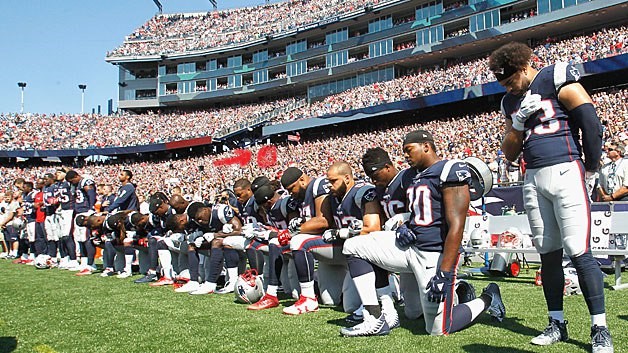
It seems the commotion has died down some.  At the game this past Sunday, no one took a knee and I heard very little complaining about our latest ‘crisis’.  I saw a few t-shirts with “I Stand for the Anthem” but that was it.  It’s been a few weeks since NFL players started to engage in civil protest on the field.  Time for some reflection.

I was in the stands (see arrow above) for that first week when players took a knee.  And I yelled “booo”  just before the anthem started.  Then I sang out loud with my hand over my heart, just like I always do.  We frequently tap someone on the shoulder, “hat,” reminding them to show respect.  That’s what you do.

I don’t think you should protest during the National Anthem.  I don’t think you should desecrate the flag.  There are certain symbols of national pride that you don’t mess with.  But I would defend anyone’s peaceful demonstration against these symbols, should they decide it was necessary, and the government tried to take that right away.  That’s not what this country is about.  Freedom of speech and expression is what we are.  It’s what makes this country awesome.  It’s why we engage in civil debate.

I don’t believe that a conscientious protest disrespects service members, first responders or anyone.  Exercising your individual rights guaranteed by the Constitution, upheld by governments and defended by our military, is the single greatest thing you can do to show respect for people that died for that right.  Imagine fighting for something that no one cared about.  I care about freedom.  I don’t take it for granted.  It is important to remember that even as you protest, we all recognize how profound the struggle to maintain your ability to lodge that protest.

But in that same thread, I can also exercise my right to criticize a protester.  Hence my boo-ing.  Personally, I think a better way would be to do it like Dallas did that first week: The whole team, even the owner, came down on the field to take a knee right before the Anthem, and then stood for its singing.  That was profound.  That was a demonstration of protest.  I thought it was pretty awesome.

Expressing concern and raising awareness about police brutality and the disproportionate arrest rates for black men is noble.  It absolutely should be done.  Professional athletes have been blessed with a talent that allows them to be celebrities and heroes.  They have huge followings.  Leveraging that star-power to communicate to an audience is admirable.  I wish more would do it.  I wish they would also express concern about their peers when they abuse women, or general disrespect of women in language and action.  Imagine if they also praised the responsibility of actively fathering children and being part of a child’s life.  Or vigilant use of birth control.  Or encouraged kids to try hard in school.  There are myriad issues to protest and raise awareness with your soapbox.  Do more than one.

I would encourage players to not just make a silent show of solidarity with something as trivial as taking a knee.  Stand up and speak.  Get out and talk to kids and men and associations.  You have a voice and if you believe in something then you owe it to your audience to talk about it and be vocal.  Show your following that while actions speak louder than words, it is the actual words that convey meaning.  Take ownership of what you want to say, and say it.  Get off your knee, stand tall and proud, and then shout it to the world.  We are listening.

Posted in Uncategorized | 1 Comment

All Hands (and Feet)

delete

If you have ever run a meeting where people fell asleep, you suck. I know it happens all the time. Leaders drone on, with no inflection, and can’t engage the audience. It’s painful. I used to gauge my presentation skills by whether my boss’s boss (TB- notorious and self deprecating about it) would doze off. I learned to be animated and make jokes to keep TB engaged. Once while my boss was presenting in a room with the three of us, I saw TB doze off on the opposite side of a conference table. You might be boring.

I know managers who can’t accomplish anything without a meeting. What a waste of time. If you can’t make a decision without pulling together 6 people who have better things to do, just so you can feel ‘fluffed’ by the decision, you suck. Stand up and lead.

Some things are truly done best in a group meeting scenario. The stereotypical All-Hands meeting should be a time for the company to come together and share in the fact that you are all one team with one set of goals. When you review results of the past year/quarter/month, you are celebrating the fact that everyone, regardless of department, owns these stats. It should be more interesting than a PowerPoint deck read to us, like a lullaby. Every All-Hands I have ever been to was super boring, it shouldn’t be. I vow never to do this.

An All-Hands meeting should be fun and engaging and keep you awake. Here is my agenda, you will understand why ‘feet’ are involved.

1) 8 deep box breaths (4 seconds each: In. Hold. Out. Hold) – 2 minutes

2) Warmup (jumping jacks or brisk walk or jog) to get blood moving. While this is going on, leadership will review mission, goals, purpose of the company – 3 minutes

3) ROM (Range Of Motion)

  • 15 Leg swings forward and back
  • 10 Arm circles forward
  • 15 Leg sweeps (side to side crossing in front)
  • 10 Arm circles backward
  • 15 Hip rotators, forward
  • 10 Arm up back and overs
  • 15 Hip rotators, backward
  • 10 Hi Jack Hi Jills
  • 10 Wrist and ankle rotations, both directions
  • 10 Press-Press-Flings
  • 10 Knee swivels (shaking the foot hinging sideways at the knee)
  • 10 Hip twists
  • 10 Swimmer chest stretches
  • 5 Neck movements (fore and back, side to side, twists, rotations-both directions)
  • 15 Cherry pickers

While we do ROM drills in unison, all of the company metrics and stats are discussed from PowerPoint slides with a rep counter running in the corner – 15 minutes

4) Strength Stations

I would set up 4 stations with exercises at each. These could change at each meeting. Things like air squats, pushups, situps, supermans, deadlifts, thrusters, etc. At each station the associate needs to goal set in a way that they feel contributes to the company. We could write them on a poster or even better, record a selfie video. I would do 2 goals for the company, 1 goal for professional development, and 1 personal goal (family or individual). Yes, your work evaluation should include how you execute on your personal goals. Members of the management team should be at each station, encouraging employees and cheering them on, while discussing their goals. – 20 Minutes

5)  Cool down. Stretching of all major muscle groups

At this point everyone is jacked up and has their blood flowing. Time for leadership to talk about the future. What are the goals for the company, our shared target metrics. None of this wishy washy crap, be specific. Talk about how it impacts the major teams and individual associates. – 20 Minutes

I know what you are thinking, this is so stupid Who are you to make me do exercise? This isn’t what I signed up for when I joined this company! Well I believe in people. And if you believe in a person, you want them to live, you want them to be healthy, you want them to grow and be stronger. That doesn’t happen by sitting in a cube, or in a conference room, or large assembly. Stagnant. Almost asleep. If the health of the company is discussed at an All-Hands meeting, we should also make it a critical fact of the company’s health, that the health of our people is symbiotic. How could it not be? Get up and move. You can have an All Hands (and Feet) meeting, that gets something done, doesn’t waste people’s time, and keeps everyone awake.

Posted in Uncategorized | Leave a comment

Speed to Market

Photo_010106_001

A little ways back I was listening to an interview with Derek Sivers, former CEO of CD Baby.  While I often find it hard to come to decisions, I’ve made some big ones lately.  It got me to thinking about the Sivers interview.  He said that when presented with a choice, he has one standard, “Hell yeah or no.”  Now that I am focusing on decisions, I like this framework.  He was saying, either I absolutely love it, or I’m not touching it.  If I don’t absolutely love it, it’s not worth my time.  I’ve been doing that by accident lately, but I think it needs to be institutionalized.  Given how short we all are for time these days, is there any other standard that you should apply?

Sivers also talked about his attitude once he makes a decision, and this one rang true to me and how I approach life,

The Standard Pace Is for Chumps.

People always talk about how the journey is part of the adventure.  That has always troubled me.  I might make the most of the journey because it takes a while to get somewhere and why not enjoy it… but I want to get there!  Just because I make the most of the journey, doesn’t mean that I focus on it.  I hate waiting for something to be done.   And while I hear all your snickers about me getting house projects completed in a reasonable time; just because I don’t finish one project before moving on to something else, doesn’t mean that I LIKE that.  It drives me nuts and I have always tried to resist the pressure best I can.  Moreover, when others see something as “done,” all I see are the details I didn’t finish.  That stuff makes me crazy.

I’ve accelerated some parts of my life, and others have dragged.  My proudest accomplishment in executing speed to market, was finishing my degree at Bentley in 3 years.  I’ll leave the details for another time.  There was a point in my career where I made a jump to consulting with relatively little experience and for a while I did well.  I also made Director at Fido relatively quickly.  But the stagnation has been killing me.  Ten plus years in the same place can really sap your spirits.

Sometimes you just need a mantra or two to add to your self motivational routine.  The standard pace is for chumps.  Time to execute and deliver.  Hell yeah

Posted in Uncategorized | Leave a comment

Why I Write

First they came for the Communists
And I did not speak out
Because I was not a Communist
Then they came for the Socialists
And I did not speak out
Because I was not a Socialist
Then they came for the trade unionists
And I did not speak out
Because I was not a trade unionist
Then they came for the Jews
And I did not speak out
Because I was not a Jew
Then they came for me
And there was no one left
To speak out for me

-Martin Niemoller

I’ve always been a fan of this poem. It reflects sentiments I’ve long held about; Speaking out against something I don’t like, Tough questioning in a business meeting, Getting in a friend’s face when they do something bad. If I don’t speak who will? Everyone does their part to repel evil. None of us can do it alone, but we all must do some.

If you agree with that notion, the same extends to environmental concerns too, right? Each of us does a tiny bit to save the environment. We each do a small part in saving the world. We each do a small part by voting. By showing kindness. By offering friendship. By sharing love.

A lot of my friends have been critical of my blog posts that are political. But if I don’t speak up, who will? My one little voice is part of the symphony of voices we hear every day, expressing their right to speak. A right we hold to the strictest of scrutiny. I not only have the right, but if you believe in what I am saying, I have an obligation. So do you.

I have tried to stop posting soliloquies on Facebook. And I try not to retweet anything that doesn’t come from a reputable source or is actual video. I reserve my words for this blog to take a more measured look at issues than the social media channels that reflect a nation addicted to screaming, paparazzi, click-bait, vitriol and hatred. We should be better than that.

So I speak up because someone has to. I speak up because it is my duty as an American. And I promise to defend anyone else’s right to speak up too, no matter how much I disagree with what they are saying, or doing. As long as I do, there is always someone left to speak.


Posted in Uncategorized | Leave a comment

Accepting Defeat

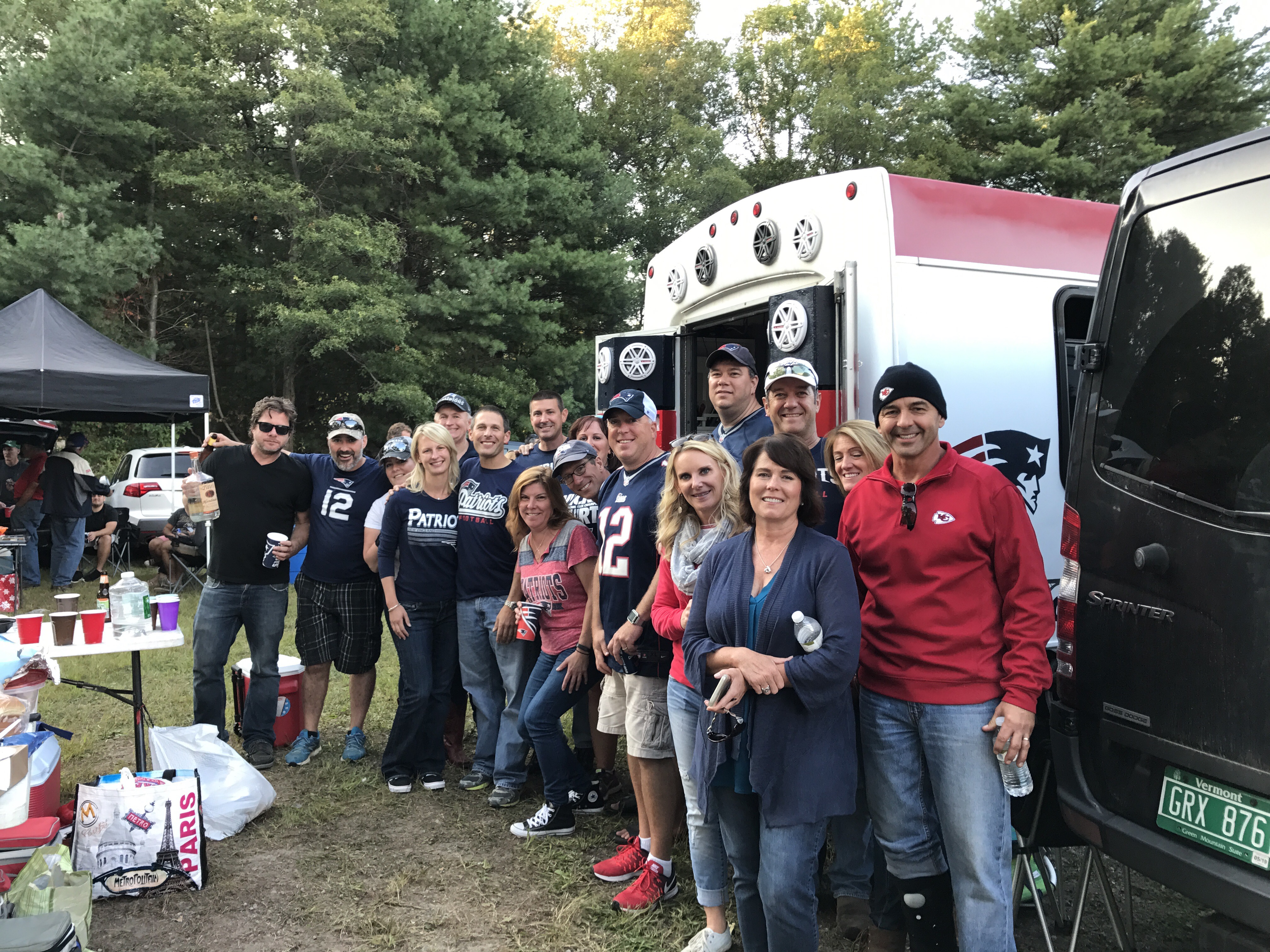
October 1, 2017.  It’s a game day. Patriots vs the Panthers.  All around a nice day.  Good weather, warmer than I thought it was going to be, So Sara and I went into the stadium over-dressed.  We spent the first half in my seats and then went down to Sam’s area to watch the second half with the whole crew.

It was a good game.  Patriots started out strong, but quickly slumped.  They came back and tied the game with 3:09 left in the 4th.  Somehow the defense couldn’t hold out and a last second field goal by the Panthers won the game 33:30

Don’t get me wrong.  It was defeating to go through that.  But the walk back to the tailgate (.85 miles) gives you some time to think.  There is a lot of conversation in the crowd about the refs, or the Defense being horrible or why couldn’t we just do x.  Sara and I usually find a way to talk about what’s next: What food we have left for quick snacks, we need Gatorade and hydration, what is there to grill, what are we doing after we get home.

As we got back to tailgate there was some ribbing commentary about why some people hadn’t started cooking, why they were so lazy, etc.  Within minutes we started eating and joking, playing music and watching the 4:30 games on the TVs.  Steve (newbie) is stressing, “Why are you guys not mad?  That sucked!  I’m so pissed and you guys are joking around.  Doesn’t losing like that bother you?”  He was half joking, but you could tell the loss bothered him.  Most of us just brushed it off.  It’s a loss.  On to Tampa.

I didn’t think about it much at the time, but later I got to thinking about this situation.  Losses don’t bother the core group much anymore.  Sure, we hate playoff losses because that is the end and the finality is painful.  But regular season losses you bounce back from.  You never lose, you just learn.  I love that expression.  Steve was new to our crew.  The rest of us have been to more than 100 games.  This is a routine.

That made me realize what it was that led us to recover so well and Steve had trouble.  We surround ourselves with people and activities that make us feel better after a loss.  We don’t just mentally “move on” we find physical things and actions that are positive, in our case- tailgating.  Having that focus makes it easy to brush off the loss. People always talk about having positive influences in your life, it actually does work.

In the moment after a loss or failure, too many companies focus on the after action review.  What happened.  We need answers.  But the perspective is all wrong.  You are still a loser.  You can’t analyze the loss when you feel like that.  Move on.  Find something positive to focus on, get your mind and the collective soul of your team back to a good place. Make it a ritual.  After the game, do something positive.  Doesn’t matter if it is a win or a loss, find a way to get back to focusing on what is good, what has potential.  Build that into your culture; no matter how the score ends up, you played and fought, now you move on to the next thing.

Accept the defeat.  It happened.  Do your regular positive thing, just like any other game.  You can stay in a state of feeling like a loser, or you can accept it.  And then you realize, “We’re on to Cincinnati.”


Posted in Uncategorized | Leave a comment

Twitter X2

I have to admit, I was bearish on Twitter for a long time. I only came to really appreciate the platform in the past few years.

But I don’t appreciate it the way it is used. I appreciate the potential and what is hinted at.  I really hate all the vitriol. The hate that comes down when you post something tagged in a way that lures the trolls. I admit, sometimes I pick fights back, but for the most part you have to ignore the noise. I think what I hate most is the fact that the Twitter Trolls just exemplify all of the worst traits of humanity.

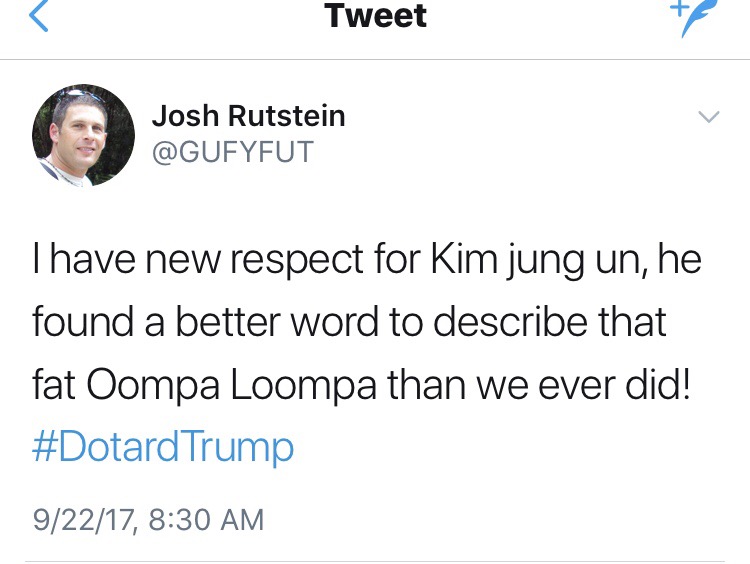
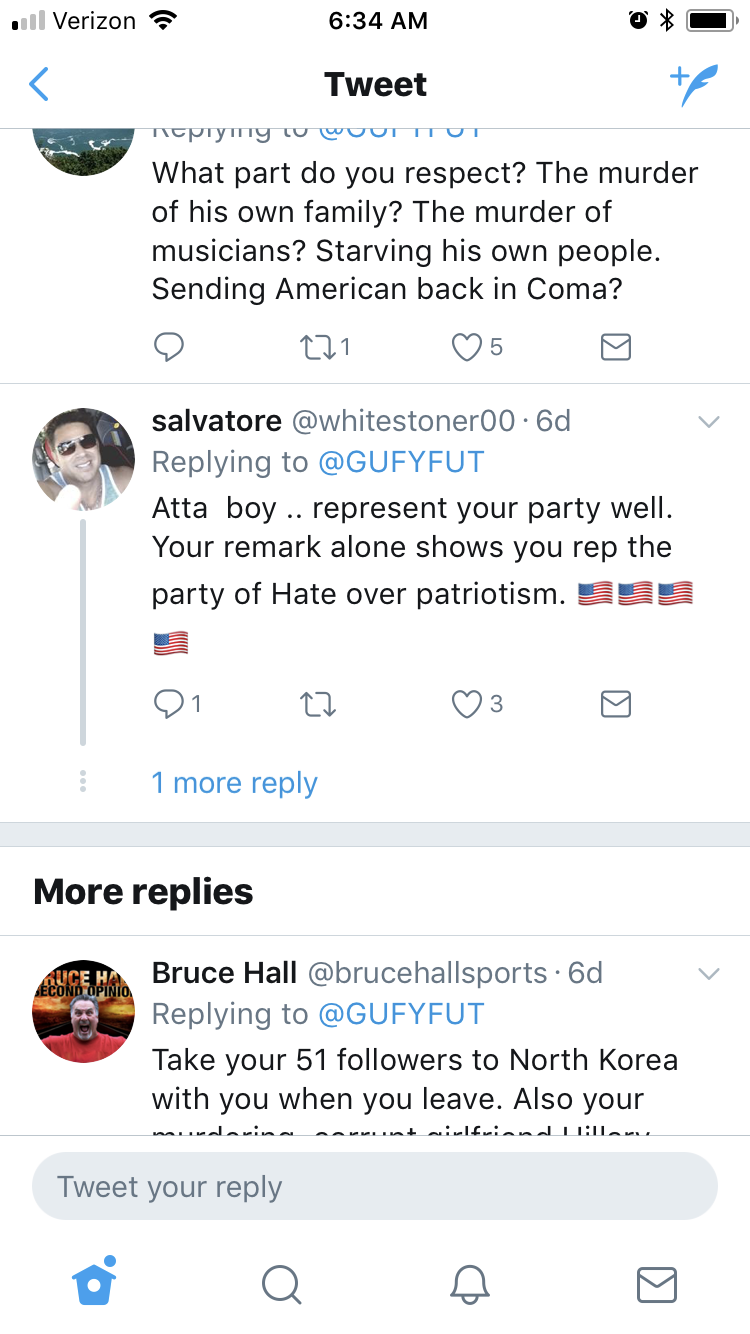
Take this tweet I posted. Genuinely, I thought it was funny that Kim Jong Un found an English word that almost no one (including me) ever used. I respect that. That is the same as I respect Trump’s simplistic use of Doublespeak and derogatory nicknames to lure in fans who can’t think beyond the complexity of arguing a policy with trash talking. Here, he got out trashed. “Dotard” beats “rocket man” any day. Am I using incendiary language to talk about our orange fatty president?   Sure.  But he IS orange and fat!  I didn’t say he doesn’t love America.

But of course the specificity of my “respect” gets lost in a world of ‘gotcha’ journalism.  Because I used the word “respect” and the enemy’s name together, clearly I must be an enemy of this country and a traitor worthy of hanging (before you quote that line, it is sarcasm).  Those that sought out my tweet and felt the need to reply, must certainly agree.  I even pointed out that their boy Trump says that he has “respect” for Putin. They don’t get it. 

I guess I find it most amusing that they accuse me of all people of being a liberal democrat, when Trump legitimately was one. Whatever.

I also agree that Twitter quips are kind of silly and don’t add any real value to the platform, yet I still use them too.

But what I like about Twitter is the potential to become a news gathering platform. Boiling an individual fact down to 140 chars is a great way to turn news and observations about the world into structured data. From there at the very least, news commentators could all start with the same set of facts. The problem, of course, is in weighing the validity of each fact.

And here is where I think Twitter is going wrong. I liked when they started certifying users as being the real person they are. It was great for influencers to get official cred on the platform. Certifying the data (who the poster really is) was the right trend.  But this 280 character thing is a waste of their development efforts.  140 is fine for a fact.  All this does is enable people to be wordy and waste my time. I would much rather categories be applied to tweets so we could start to verify those categories (Fact, Opinion, I-Heard-From-Someone).  I would also like to classify context (Eyewitness, Interpretation, Recalled-Event).  Adding columns to the data would make filtering a much more straightforward process when searching for information.

No one at Twitter is going to care what I think. And I doubt I will continue keeping within 140 chars.  But I still have hope that Twitter and even the trolls will evolve. Maybe I just need to double my hope. 

Posted in Uncategorized | Leave a comment

Going It Alone

DSC04218

The other day I watched a webinar with two managing directors about what it takes to join Techstars.  The first discussion point was about solo founders.  I’ve been wrestling with how to talk about my own status as a solo founder so I am going to try to create a narrative about not just why I think I can be successful, but also possibly help other entrepreneurs formulate their case.

The theory of a ‘team’ to start a new company is that you bring together people with complementary skills.  Typically at least one is technical and one product/business focused.  I think this strategy is really useful for young founders.  Their breadth of experience is just not broad enough to extrapolate how to handle new situations on the side where they have limited expertise.  I’ve noticed this more in the past few years as I get more face time with newly minted college grads in our office.  Note that we hire some very well qualified candidates from top schools, but they still lack skills (architecture, customer focus, basic understanding of business, politics).  But if you put a few younger people together, you usually cover enough ground to make them effective.  In which case, multiple co-founders make sense.

Between my finance degree, accounting stints, and years in consulting, I have a pretty solid background for understanding ‘business’.  I’ve spent a number of years recently as both project manager (making sure a team gets things done) and product manager (setting the vision for what the team is going to do).  No one would call me a ‘techy.’  However, I have fairly decent SQL and database design skills.

But what I really do well is something that many can’t.  I can work with a customer to craft a vision for the product, design a flexible solution for that problem and then communicate that concept to a development team.  Over the past 14 years of being at Fidelity, I have been coordinating these efforts with teams in North Carolina, Texas, Boston, Ireland, India, and China, all from our home base here in NH.  At the worst, my dev team was split among 4 of these sites simultaneously.

Sometimes I did well.  My most recent design challenge leveraged 20+ developers working on a solution in multiple sites on different components and technologies.  We came in on time and under budget.  Other projects were not so successful.  On one, our inability to convert large datasets accurately, led to missing our install window by a full quarter.  I have worked dozens of complex projects and learned from each one.

These experiences have proven to me one undeniable and consistent fact.  It is the strength of the design that was the most important factor in our success.  We worked most effectively when I was in sync with the team, communicating the concepts to the developers, letting them work through the details in the code.  Between shifting sites, pro-serve resources and changes with business partners, we are always cycling new associates in and out.  As long as I could brief them on the vision, their part in the whole picture and what was expected, things went well.  Unfortunately, perpetual change is a reality on any project, and subsequently managing that change is a critical skill to success in a project that is scaling.

Further, when I truly understand the problem and 100% own the solution design, I can work with any team.  Experience affords you the ability to talk to people and build a relationship because inevitably you have shared lessons that help bridge the gap of newness.  Team is more than proximity or friendships.  It is empathy, understanding, communication and setting clear goals.  It is also culture.  Books such as Extreme Ownership, and Team of Teams have taught me lessons that I use to build culture every day.

As I look to head out on my own and build TheMissionZone in earnest, I have decided that being a solo founder with a virtual team, is the optimal strategy for me.  (I also plan to write code, because it is a valuable skill.)  I believe that creating the infrastructure where I am able to grow an organization designed to scale right from the outset, is the best way to deal with challenges that will arise later.  Also, since I am not 100% sure what parts of the product are best to develop first, I can’t necessarily nail down the skills needed for a technical co-founder.  Flexibility now, is my most important HR asset.

There is also the ‘too many chiefs’ problem.  And I don’t believe this should be understated.  I keep hearing about startup founders that fight, disagreements on vision, market segment, etc.  Given all the input that is available through customers, colleagues, coaches, mentors and even through professional meet-up groups, a CEO really doesn’t lack objective opinions.   A co-founder has the potential to muddy the decision making process.  Right now, I don’t need that.  I need to move fast and break shit.

And then there is the whole ‘adult’ problem.  I am old.  There is no “living on ramen” for me.  I couldn’t convince my peers to quit their job to come join me.  Getting paid in equity for a 23 year old living at home is fine, but it doesn’t feed the kids.  My network are all adults, they have real lives and families.  Would they quit and take a pay cut for a paying job with equity and added flexibility without the political BS of the corporate world?  Probably.  At some point I will start making those calls.  I may be able to get myself into a comfortable position to quit my day job, but I can’t reasonably expect that of others.  Many of these friends continue to be advisers and I lean on them constantly.

Given what I have laid out above, I know I would function well as a solo founder.  But how does this fit into a general set of personal characteristics and approach that might help determine if you might also be well suited as a solo founder?  I will try to spell out those desireable characteristics below…

  • Have a rock solid design.  Create a design based on components so you can leverage a disparate team
  • Design for interoperability of the plug in components
  • Know your culture before you start, it can always evolve, but there has to be a foundation and understanding for those that join.  People want to know what they are walking into
  • Have a plan of how you will scale the team both temp resources and full-time
  • Be sure you define roles well.  Have experience motivating and inspiring teams, coaching underperformers where necessary
  • Have a broad network and feel comfortable tapping it
  • Know your MVP before you build it.  You should already know the first test case and tackle it.  Pivot later
  • Have damn good project management skills and understand how to work in a matrixed environment with multiple priorities
  • Be awesome at communication.  Know how to write clearly and coherently.  Know how to draw pictures to communicate with those for whom English is not their first language
  • Be humble and work with your customer to define a true requirement and how to solve problems most effectively.  Don’t just survey, understand the answers to questions
  • Have some sort of technical skills.  Understand how code has a logical progression and data tables can impact code.  Know how to communicate in boxes and lines.
  • Be able to visualize how rules based code will enable you to scale and not create hard-coded technical debt.  Recognize each of those tradeoffs
  • See the big picture of product and customer and revenue and partners
  • You must have basic accounting/finance skills.  Know time value of money, budgeting, spreadsheet modeling with variables, and product costing

This is not a complete list by any stretch.  I will continue to evolve this post over time.  Please give me feedback in any form!

There is no belayer or grigri when you are a solo founder.  So climb when ready…  Climbing!

Posted in Uncategorized | Leave a comment

We Don’t Work on Powder Days


People always complain about how bad their employer is. They don’t care about me. They don’t support me. They don’t give me flexibility. I believe there is a way for a company to both instill loyalty from employees and in exchange, structure work so that employees are happier than they would be under a traditional work arrangement. I want my company to be genuine in its care for employees.

It starts with a recognition that no skier wants to work on a powder day. For those unfamiliar with the lingo, a powder day is a day on the mountain just after or during a huge storm that dumps a lot of snow, creating epic ski conditions. A powder day is foreseeable.  Usually a day or two before the storm, the weather guys will predict a storm, blizzard or massive nor’easter.  Timing for the day is critical. You want to be there as soon as you can to enjoy the snow before it gets all cut up. Powder days are rare. In the northeast you get maybe 4-5 per season. That makes them special. The enjoyment of a powder day, can make the whole season. They are the memories you cherish most. 

A powder day is a metaphor for times when you don’t want to be at work. It’s when something awesome and unplanned happens on a weekday.  Your Powder Day could be a school graduation, prom pictures, award ceremony, kid soccer game, World Cup in town, or sunny beach day. It’s whatever you hold most dear that is predictable, important, timely, and when you don’t want to be at work. 

My philosophy about a powder day is that I would gladly work more on the day before, the day after and maybe even check email periodically on the day, to take a guilt-free day off to head to the mountains the night before to enjoy fresh tracks on a blue-bird day. It’s not a vacation day. It’s a choice. Hell, I would gladly work both weekend days in exchange for actually getting first chair on a powder day. Yeah it means that much. 

The lesson is this, I want people working for me that know what they want in life. I admire people that have something that drives them. Something that makes work worth doing just to support your addiction. These people are your keepers. More importantly, if I give them the ability to experience the thing they love, even when they normally would be expected to be working, that drive extends onto the company that gave them that ability. 

If you want employees to care about the success of your company, then your company better care about the personal success and happiness of its people. The way I will do that is by employing a simple philosophy: People know they can get work done and they will gladly get it done when it makes the most sense for them, given competing priorities in life. Priorities include more than just personal/family sickness and emergencies. It includes the stuff that makes you happy.  We would gladly make trade offs for powder days. 

I am always happy when I am ripping down a mountain, snow kicking up in my face, cutting fresh tracks through 2 feet of fresh pow.  No company that I love, would make me miss that. I don’t work on powder days, neither should you. 

Posted in Uncategorized | Leave a comment