Ending [blank] As We Know IT

I can’t tell you how much this expression drives me nuts. It has become a tag line for change, when someone doesn’t want change. That will end Social Security as we know it. Don’t trust him, he wants to end Medicare as we know it. Shut up already. EVERYTHING ends “as we know it”. Health insurance (not health “Care” which hasn’t changed at all) ended “as we know it” with the passage of the Affordable Care Act. Medicare, with the passage of the prescription drug benefit ended “as we know it.” A person’s life ends “as we know it” when they get married. The reason it ends “as we know it” is because any change inherently leads to something which we can’t know with a high degree of specificity.  But that doesn’t make it bad.

I have to say that as of today, I think that Libraries must end as we know them. I will bet that you will agree this is not a bad thing. I only know one librarian, and I am curious if she will agree.  KB-B?

Haley has a research paper assignment for school. One of the things I like about the way schools are handling the onslaught of easy access via the Internet, is that they often make kids utilize one book as part of their bibliography. Haley chose to do research on Leonardo Da Vinci, arguably one of the most influential artists and inventors of the Renaissance. So I honestly did not feel much of a sense of urgency in finding a book at the local library, due tomorrow. Now I don’t fault the library here, but we couldn’t find one single (non children’s) book about this very famous person. We asked for help, we ran searches, we even used the new cataloging system. [Spoiler alert – the Dewey Decimal system is slowly being replaced] I found this both preposterous and disappointing.

Like I said, I don’t think this is the library’s fault. Between fiction and non-fiction, maintaining inventory for every possible nugget of information that has ever been assembled, is impossible. Physical books are just too cumbersome, labor intensive and expensive to maintain at the smaller libraries.  After we got home a B&N search yielded some possibilities, though since I can’t actually thumb through the books, I have no idea what will really work for Haley and I will have to pay $11.99 to resolve just one option at the top of the list.

In my opinion the basic premise of the library boils down to three things:

  1. Proximity to consumers
  2. Perpetual availability of physical objects (books)
  3. Professional curation of literature

In the Internet age, is the physical structure of a library really the best way to do this stuff?  I like being the old-fogey and make Haley run a search and then find the book on the shelves, but I have to admit, I’d like to see the notion of Library change.

Proximity – Is there anything more convenient than a device in your house with an almost endless capacity to consume data from anywhere in the solar system (if you include satellite imagery, I don’t think I am exaggerating)

Perpetual Availability – I think we have backups figured out by now, so realistically there is no need to worry about losing data anymore.  And the tree-hugger in me would like to use less paper.  Kindle and Nook have created a physical experience that is actually better than the paper-printed word.  But we need to do better with speed, search, connectivity, and compatibility- that should be the easy stuff.

Professional Curation – And here is where I think we really need to change our theoretical approach the least, but it will have the most effect.  Much of the internet is complete shit.  If you want political news, you can’t search for the subject or you end up with some crap blog that scraped a real story, filtered it to a partisan whim and then publishes it as though it were unbiased truth.  I pick a major news outlet and search its site directly.  As of today, Jason Calacanis who tried to do curated search with Mahalo before the Panda update, released Inside.com which is curated news.  They employ professionals whose job it is to find the best content for news (from ALL sources), summarize it, and provide links back to the source.  He calls it “Pandora for news.”  Libraries are content distributors for researched facts.  Librarians are the curators, and they are indispensible.  I just think they are putting their talents to bear in the wrong place.

Side note = I’d like to focus on non-fiction, because I think the very notion of fiction lends itself to better curation via the social channels (twitter, facebook, tumblr).  In addition, the form factor and distribution problems are already being solved quite well by Amazon and Barnes & Noble.

How often do you search for something and find a Wikipedia page that may or may not be trustworthy.  Those guys have gotten better in the past few years and their source linking is pretty good, but still.  If all the best research is being published in books, why shouldn’t we have a better source and better curated system of distribution for all of this great content?

Imagine a librarian, who might actually edit the Wikipedia page, expert in a subject area, whose job it is to curate all the best thinking about that subject.  You seek out the librarian to help you understand the subject in the level of detail that is pertinent to you.

I have no idea what we spend on libraries and librarians, but I can only dream about how much better my research experience could be if we were to deploy that human and infrastructure capital in a more efficient manner.  I’m sure the perfect 5th grade level Leonardo Da Vinci book is out there somewhere; it would be nice if someone could have helped me with that… and it was on Haley’s Nook right now.

Posted in Uncategorized | Leave a comment

Thinking Like a Leader

I’ve read a little about executive coaches in various blogs.  I always chocked it up to advice for 20 something CEO’s fresh out of college tech programs who really don’t understand how a business works.  A few months ago we started a program at Fido that I didn’t even realize was coaching until I looked up the facilitator.  Free plug to CRA.  I have to admit, I am a convert, it was an exceptional experience.

I didn’t necessarily have 1:1 coaching, but our group of 15 or so Directors formed a pretty good bond over the 4 months.   In some ways I think I actually got better perspective by John introducing topics, concepts and best practices, and then letting the group provide color based on experience.  It was certainly beneficial to me as I always thrive on alternate perspectives.  Some I agree with and some I like to sample, if for no other reason than to excercise my thought process for disagreeing.  Some of what we learned is universal, I’ve even used some of it with the girls.  We had a great discussion last week about how Megan and I can trust them to do their jobs (school, chores, sports), treating us as a ‘boss’ that grants them more responsibility as they perform at a higher level.

But I think most of the really good stuff was about not following the tradewinds.  Leaders have a good idea of what they believe will work and then spend their time not convincing you that they are right, but helping you see that vision as the utopia it is.   Successful leaders actually build what they concepualize.

For the last session we all read an essay, that I have to say is one of the most insightful discussions of leadership that I have read.  It is a lecture that was given at West Point in October 2009.  A few things stuck with me.

  • “That’s really the great mystery about bureaucracies. Why is it so often that the best people are stuck in the middle and the people who are running things—the leaders—are the mediocrities? Because excellence isn’t usually what gets you up the greasy pole. What gets you up is a talent for maneuvering”
  • About David Petraeus (pre-affair) in the context of the Counterinsurgency Field Manual   “No, what makes him a thinker—and a leader—is precisely that he is able to think things through for himself. And because he can, he has the confidence, the courage, to argue for his ideas even when they aren’t popular. Even when they don’t please his superiors.”
  • About a study of college students multi-tasking “…people do not multitask effectively. And here’s the really surprising finding: the more people multitask, the worse they are, not just at other mental abilities, but at multitasking itself.”
  • Which leads to “Multitasking, in short, is not only not thinking, it impairs your ability to think. Thinking means concentrating on one thing long enough to develop an idea about it. Not learning other people’s ideas, or memorizing a body of information, however much those may sometimes be useful.”
  • And most importantly “I find for myself that my first thought is never my best thought. My first thought is always someone else’s; it’s always what I’ve already heard about the subject, always the conventional wisdom. It’s only by concentrating, sticking to the question, being patient, letting all the parts of my mind come into play, that I arrive at an original idea.”
  • I wrote about some of this before, but I like this passage about sourcing news/ideas from Twitter or Facebook “…you are continuously bombarding yourself with a stream of other people’s thoughts. You are marinating yourself in the conventional wisdom. In other people’s reality: for others, not for yourself. “

One of the most important themes I took out of the sessions was the need for me to be me.  Every so often I slip into a mode of feeling that I need to play the Fido corporate game and figure out the best way for me to move ahead.  It forces me to want to check my creative self at the door and build a team that reaches concensus and presents an integrated approach to some idea that really doesn’t do much of anything in the world.  But when I think about what that means, about what i would actually have to do, I am disheartened.  It shouldn’t have to be like that.  I want to do great things and make a difference in the world.

I remember reading that Bill Gates used to take a few weeks every year and get some solitude with a stack of whitepapers and notebooks (he probably went to The Yellowstone Club…jealous).  To a lesser extent, I have done this up in VT, but it is something I really want to focus on in 2014.  Finding time to think, imagine, and strategize.  If I am going to be successful, it will only be by imagining the way that things should be, and then executing a plan to get there. 

The class inspired me to really start moving on my startup and focus on making that happen.  This has been years in the making, but I am finally getting around to making it real.  As we roll into 2014, you will see my posts become less political and more focused on making this thing successful.  Please stay tuned, my best, most thoughtful and forward thinking work is right around the corner.

Posted in Uncategorized | Leave a comment

The 4-Song-Set

Later today is the last Pats game for the regular season.  Each week preceeding a home game, either Sam or I send a note to all attendees detailing time, place, food, etc.  Inevitably, we have a newbie and I have to tell them about our music system.  I am tired of doing that so I will post a longer version here.  If you are attending the Slappy T-Bone Tailgate Extravaganza, be sure to read.

History

When I first built the Tailgate Box, I figured we would mostly play the radio while tailgating, it was the easiest solution and sometimes I like listening to pre-game.  Within the first few games, I remember connecting my iPad on shuffle and let it play.  CMAC was there one week and of course he had complaints.  So he played some songs, and others joined in as well.  The following week we debated a new system wherein everyone would get to play a few songs.  We settled on 5.  That week I decided that we would DJ in order of seniority, so I went first.  This too was not well received (there were tears- as Sam likes to say).  And so through several iterations we have arrived at the current system, which is not without its rules.

The 4-Song-Set

The whole point is to let everyone play music and build a camaraderie with the crew and to a lesser extent, our neighbors.  We play music LOUD.  It is hard to have a conversation, and if you have some small radio, it will not be heard.  Too bad.  Use text because phone calls do not go well.  4 songs is just enough to build a rhythm.  Or put together a theme.  A lot can be said with 4 songs, but it’s not too long that you get overwhelmed.  It forces the player to put some thought into the list and create an order that really works.  It allows flexibility but yet forces you to make tough choices.  It really is beautiful, I am quite proud that Chris, Sam and I have really evolved it to where it is.

The Rules

  1. Four songs means 4 individual tracks.  The Eddy-G rule was created aptly for Ed who insists that “intro” tracks don’t count.  Tough luck, they do.
  2. Each track cannot be longer than 5 minutes.  This is the Spence-Rule, so we don’t listen to 45 minutes of Pink Floyd.
  3. You must have the playlist assembled and ready to go on a device that can play through a headphones audio jack (3.5 mm stereo).  No Spotify, YouTube or Pandora.  Have the music local.
  4. When we arrive at the parking lot, numbers are chosen at random to designate the order of play.  If we run out of time, tough.  If you are in a port-o-john or playing Cornhole and miss your spot, tough.  Pay attention, Eddy is always there to jump in if you are pre-occupied (endless supply of Cheap Trick not withstanding).
  5. This is a tailgate for football, music should be appropriate to that scene.  No dance music, crappy pop, or country music.  Rock and roll is where it’s at.  If it is played on Jamn or Kiss… NO!
  6. If you play it, you better be ready for the criticism.  If too many people object, you will get the gong (btw guys, we should totally get a real gong for shit music).  The only exception to this rule is for myself, since it’s my setup (too bad a-holes).  Sam also has carte blanche, remember that he might poke you in the sternum, and Jim Croce is cool.
  7. Hard rock, classic rock, southern rock, alternative, metal, punk, funk, 80’s hair bands, and modern rock are all accepted.  e.g. AC/DC, Guns & Roses, Allman Bros, Van Halen, Iron Maiden, Rage, NIN, Michael Jackson and Stevie Wonder (both musical geniuses), James Brown, The Ramones, Led Zeppelin, Motley Crue, Def Leppard.
  8. Rap is ok if it is classic and has character.  e.g. Skee-low, Run DMC, Eminem, Beastie Boys, Public Enemy, Slick Rick, Eric B & Rakim, Snoop
  9. No Chicago (sorry Loren), INXS, Hall and Oats, Alanis Morrissette or anything that makes you fall asleep.
  10. There is an exception to rule 9 for covers.  If a cool band covers a bad song but kicks ass, play it.  Cmac and Jiffy are masters here, see The Dan Band.
  11. Themes are strongly encouraged.  All covers, all angry music, all one band, all funk, etc.  These have been well received
  12. Obscure songs that remind you of childhood are awesome.  If a song comes on and someone points at you with a head-nod, you did well.
  13. Order is important.  Make sure you build to a cresendo.
  14. Try to limit the number of swear words used in a song.  Zero is best.  We aim to be family friendly, even while being obnoxiously loud.

I am sure that I will add some more rules as people remind me of things we have experienced in the past.

The 4-Song-Set is meant to express a feeling, it defines who you are.  If CMAC plays No Speak Americano just to make Sam crazy…yeah you get it.  As the token old guy, I like to lead off with an oldie.  Little Red Riding Hood, Poison Ivy did not go over well.  But then that says something about me too: Screw you, I play stuff that you should know.  And it says something about me that I do what I want, don’t care what people think, like the classics, and will think out of the box (Punk Rock Girl, Ray Charles’ Mess Around, The Blues Brothers, SRV – Pipeline) .  I am going to add a page and list out all of my sets here.  It will take a while to type them all out from my phone.  I hope people will comment on this post and either post their favorites or dream up a great set.

For today I am going with an all female singers theme,

  • Joan Jett covers the classic Hanky Panky (my “oldie”)
  • Heart – Crazy on You (awesome lead off guitar solo)
  • Luscious Jackson – Naked Eye
  • Straight Line Stitch – What You Do to Me
Posted in Uncategorized | 2 Comments

Who Carries the Sledge?

I just finished reading No Easy Day which is the autobiography of a SeAL who was part of the mission to capture or kill Osama Bin Laden.  I should have read this a few years ago when it came out.  This might be one of the best books I’ve ever read.  Ok I listened to it.  6 disks that kept me engrossed the whole time.  I picked it up last Thursday and finished it on Sunday.  While this is a great military story with some nice inside baseball details, I think there are some really good life and business lessons in there too.

A few things I didn’t know: SeAL Team 6 refer to themselves as “DEVGRU” which is a shortened version of the long name of United States Naval Special Warfare Development Group. ST6 was named artificially higher than the number of teams in existence (2) at the time to make the Soviets think we had more teams than there actually were.  SeALs apply to DEVGRU and if selected go through an additional 9 month program beyond BUD/S called “Green Team”.

Business Lessons

The author talks a lot about “the good-idea fairy” where planners and analysts swoop in late in a process with good ideas about how the mission should be executed.  He details suggestions to bring a bull horn to the raid for crowd control or the need to carry a flashing police light so they can push one of the Bin Laden cars out into the street and put this light on it so neighbors think it is a police action.  The good idea fairy is everywhere in business.  Whenever you vet a plan, someone inevitably tries to add value after the fact.  While reviews are a useful part of planning, I doubt anyone hasn’t seen it go too far when decision makers lack the courage to act and make a call.

There is a great description of different approaches to a mission.  Sometimes you “fly to the X” and come in loud and powerful with a lot of speed.  You have no element of surprise when you come in on a helicopter.  This is juxtaposed to “flying to the Y” where you land far away in a quiet place and approach the X with stealth:  Thus keeping the element of surprise.  How often is it smarter to fly to the Y and move to the X with diligence and care?

I particularly like a story of the Green Team PT test.  The author was coming in from a deployment in the field and was not in very good shape.  While SeALs are expected to far surpass the minimum standards, he barely passed.  At his interview he took responsibility and explained that this will never happen again.  I like the fact that every test, every experience is a training moment and something can be learned.  Even in the middle of on-going operations, you have to keep your fundamentals solid, sharp and well exercised.

Political Stuff

Without doubt my favorite part of the book was the ramp up to the Bin Laden raid.  I didn’t know this, but a single squad was not chosen for the mission.  Instead, guys were picked from all the squads.  As described it was an almost “Dream Team” of operators who were all at the senior level.  After they all met each other and received the mission briefing, the author asked, “Who’s gonna carry the sledge?”  It was always the new guy’s job to carry the sledgehammer.  He talks about how any of the squads could have carried out the mission, there was nothing complex or special about it.  But to prove to Washington that they could do the mission, they had to rehearse over and over on a model that everyone agreed had an amazing level of detail.

When you remember that our Commander in Chief is a basketball player, this totally makes sense.  You can throw any 5 stars on a basketball team and they can be a ‘dream team’ in minutes.  There is no ‘team’ in basketball, there are 5 guys with giant egos pounding their chests in a completely anti-cathartic rumble of scoring that repeats itself over 100 times in a 60 minute game.  Who can’t picture this guy saying “I want the best of the best before I approve this mission.”  It seems to be how the White House operates too; there is no team, there is no need to gel as a unit the way football, soccer and hockey players do.  It’s like the football analogy where quarterback and receivers could look at each other and get on the same page before a play starts.  We hear this described as ‘timing’ from getting reps in practice.  Similarly, one part of the book describes how there is no secret Navy SeAL hand signal language like you see in the movies.  They train together and are so prepared, that they know what other team members are going to do before they do it.  A squeeze on the shoulder from the guy in the back is all that is needed before you clear a room.

This last part is a great life lesson.  SeALs don’t really plan a mission with a lot of detail because no plan survives first contact with the enemy (Steve Blank says that no business plan survives first contact with customers).  So what you do is you prepare and train so that you have seen and experienced so many different contingencies in the past that reacting to something new feels natural and rehearsed.  Experience doesn’t have to be exactly relevant to the situation at hand.  Rather, experience prepares you for situations that have no preset plans.  Moving decisively while experiencing something for the first time, is leadership.  Good thing the leader of the most powerful military and largest economy in the world has multiple years of experience as a community organizer.  That’s normally the FNG you make carry the sledge.

Posted in Uncategorized | Leave a comment

We Need a Hero

I am a big Mark Suster fan and follow his blog regularly. I pretty much agree with everything he says and even if I don’t agree with things, I definitely take them to heart. Mark talks a lot about the sales process and just completed a series based on a strategy he employed at his last business (sold to Salesforce). The strategy is named PUCCKA and is an acronym for a multi-step process. The last step is “Ask” and is about openness from salesperson to the buyer and ‘asking’ for guidance in the process. I have read this before in other posts but there is one line that I disagree with in this last post that sort of pulls together this general theme. The line is a follow on to the process of how to find a “Champion” (one of the C’s) with budget authority for your product in the firm. I agree with the notion of a champion, but I don’t like this part…

If they don’t want to share that information with you then they’re not your champion and you must continue in search of one in order to be worth investing resources in this account

Here’s why.

In a large firm buying a new product, someone has to do research. That is usually a product manager, someone at the director level. It can be someone more junior, but that tends to be rare. Directors don’t do real work, they just create silly slides in PowerPoint. A director controls a low 7-figure budget. So an enterprise solution is never going to be something she can authorize. The reason is that with that budget, you are so locked into your deliverables that there is no room to buy ANYTHING else. Maybe some developer tools or small one-off licenses, but nothing for the enterprise. So while that may be the original contact for the sales person, they can’t approve squat. According to Mark, after you realize this, the salesperson should move on.

A VP has a high 7, maybe low 8 figure budget. That’s enough for little things to get lost. You might be able to choose a SAAS offering instead of building a custom module for some component of one of your products, but nothing big.

An SVP is commanding a solid 8 figure budget and at that level you can start to make build vs buy, people vs PO choices. But you can be sure that the SVP is not making these decisions on a whim. As I like to say, nothing is real until you see it in a PowerPoint deck. These guys are so busy, they might forward an article to a staffer, but they aren’t thinking about product architecture or the roadmap on a daily basis.

So what does every Director want? To make VP. How do you get there? You pitch the SVP. And if you stick your neck out and get a win, you might be rewarded. You have to be the hero. Think a sales guy is going to get a meeting with an SVP? No F’ing way. Not without her seeing a pre-evaluation in a deck presented by someone in the CoC (Chain of Command). Why? Because no SVP installs software and rolls it out, her people do. You trust the opinions of your people.

Now as a sales guy, you can skip over mr director and go right up the CoC if you want. And you can present your fancy ROI numbers, but that is all BS without knowing our hardware platforms, support model, business staffing, volume of data, etc. Who is going to do that legwork? Yup the hungry guy looking for the letters (“VP”). The funny part is that as soon as you skip over the person who actually wants your product, here’s what happens: That SVP sees your presentation and asks for competing products/estimates/options from her staff. When the ‘recommendation’ deck comes along recommending a vendor, you really think I am going to give the thumbs up for your product after you treated me like crap? Nope. Sale gone.

So what should you do as a sales guy? Find a director who wants your product and make them a hero. If I watch a webinar and give you my email address, send me the damn deck! Let me steal the slides. You want to pad an estimate so everyone can trim a pound of flesh? Fine, but give me a frickin number. Give me clear guidance on a hardware profile based on my volumes. Show me configuration screens and how to work a sample use case. Give me the screen shots. Make it real. And most importantly help me build my deck! PowerPoint is like the magic weapon creating the hero in the cartoon version of corporate America.

I understand this is a subtle difference between finding a champion and helping to build a hero out of a champion, but I really think it is important. Mark refers to someone with “authority to either make the decision or to get somebody who holds budget to make the decision”. I think he glosses over the part about getting someone with authority as just part of bouncing around looking for the champion. I agree with knowing how to target deers. But every hunter knows, if you actually get to see a deer in the wild, you better have done your prep work and you definitely don’t let it get away. Finding a better buck is not that easy: You might not see another for a long time.

A hero always has a sidekick and even the sidekick gets praise from the mayor. Does it really matter which you are as long as you get your commission?

Posted in Uncategorized | 1 Comment

Immigration Reform

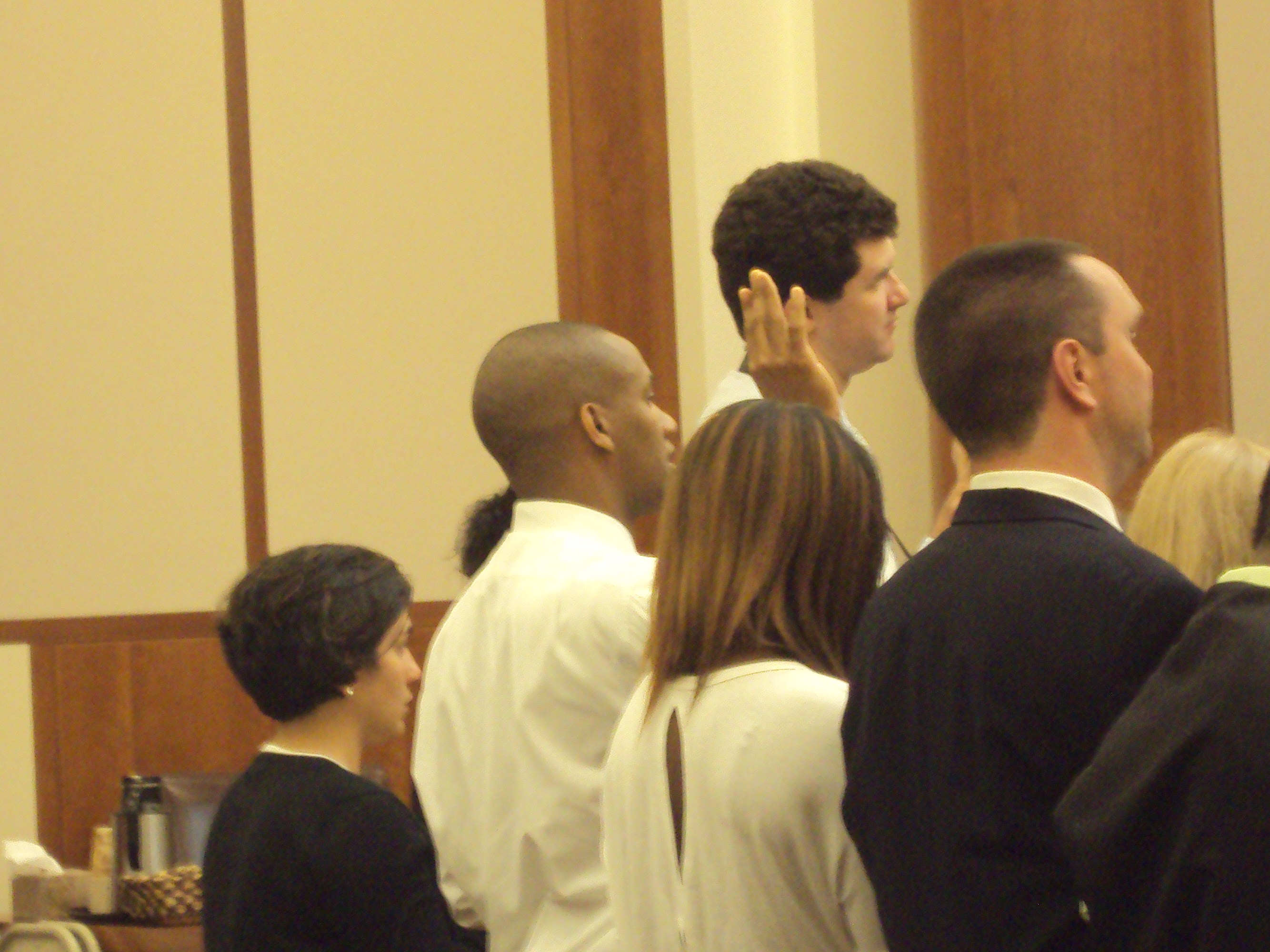
A few weeks ago I was able to attend the naturalization ceremony for my friend Joe as he became a US citizen.  I’d never seen one before.  There were over 80 people in Concord, NH coming from 42 countries.  It was a pretty special day and was great to see the families in observance and how proud they were to see someone become a citizen of the United States.  I too was proud as I have been pestering Joe to file his petition ever since Kenya passed its new constitution.

Josh and Joe - Copy

Joe is the pinnacle of what immigration reform opponents want in an immigrant.  College educated here, works in a STEM field, extraordinarily smart, good family, goes to church, etc.

When we look at Immigration Reform: Guest worker program, paying taxes, keeping top college grads and entrepreneurs here, securing the border, I can’t imagine that any of these are real showstoppers for anyone.

But I do understand resistance to ‘path to citizenship’.  Illegally entering the US is a serious federal crime.  Since some states prohibit convicted felons from voting, it seems crazy to then say that all these people that have committed a crime, should suddenly have a path to earn our nation’s supreme right.  At the same time it is conceivable that someone convicted of fraud in a state court would not be able to vote.

Time for a dose of rationality.  Who really thinks that all the degenerate scum that will suddenly be granted permanent residency status will really embark on a 13 year adventure to be a citizen?  Would I trade that possibility for the certainty of all the other benefits of immigration reform?  You betcha.  And what if the border with Mexico isn’t 100% secure?  Then as a House oversight member I would insist on hearings to see what companies were hiring undocumented workers in border states.  People don’t risk their lives, running all night across an unsafe border for the weather, they come for a job.

oath - Copy

Standing for your principals doesn’t mean that you can’t compromise on those things that you feel are important but are less important than other issues.  That is the nature of compromise.  I hope the House acts rationally and passes immigration reform if for no other reason than to show that it is not more dysfunctional than the Senate.

Posted in Uncategorized | Leave a comment

Naivety Lost

A few months back I wrote a post about gender inequality, the effects of objectifying women and their success in the workplace as a result.  I wrote about my perceptions of success and the criteria needed to get ahead.  I stand by those remarks but today my good friend Anita pointed out that there are still areas in which gender bias exists and that I was naïve to not see them.  While it is good for me to gain new perspectives from people I respect, I will take a different approach on the prescription to correct this ill.  As I walk through the approach, I think this will fit nicely in the Rational Republican series.

I was basing my perception of women succeeding in the workplace on non-technical disciplines, which is ironic because I work in technology.  I am trying to start a Women in Tech mentoring program in partnership with a local school near our campus in NH.  My email blast was fairly well received as 7 of the 27 female technologists I contacted were interested in participating.  Anita and I discussed that no VP level associates were in that mix.  The conversation moved to why this is the case and Anita pointed out two things that were really interesting.  First that while the top levels of an organization may be progressive in this area, that very often does not trickle down to the levels that would be in a position to promote women past the senior and director levels.  Second, those that do move ahead are women that put in the kind of 70-80 hour weeks similar to that of men who are successful.  Many women choose not to engage in that work:life dynamic, and so they inevitably are left behind.  This seems to be more prevalent in Tech, though I know female computer geeks that put in 80+ hour weeks, and I hope will someday aspire to the VP level. (Sara)

This second point really got to me.  As I think about the successful women I admire, they truly are logging extensive hours.  Several VPs in the finance area do, I know the leadership does, and Megan (also a VP) certainly does, especially during audit season.

OK, now it is time for me to branch out.

While this problem manifests itself in the workplace, the problem is not with corporate America.  If you do more work, you should succeed.  That is what we want, reward for effort and results.  Trying to legislate against an imbalance of power and equity that is a result of that axiom is very bad for a nation built on the notion that if you work hard you will win.  As Anita and I talked, I realized that the problem is not the macro-economic evil corporation, but the grass-roots American male and father.  Anita noted that the examples of men that are moving ahead quickly, most often have wives that take care of the details in such a way that those men can focus on work and not their family responsibilities.  The problem is men, but not men in the workplace, but men in the home.

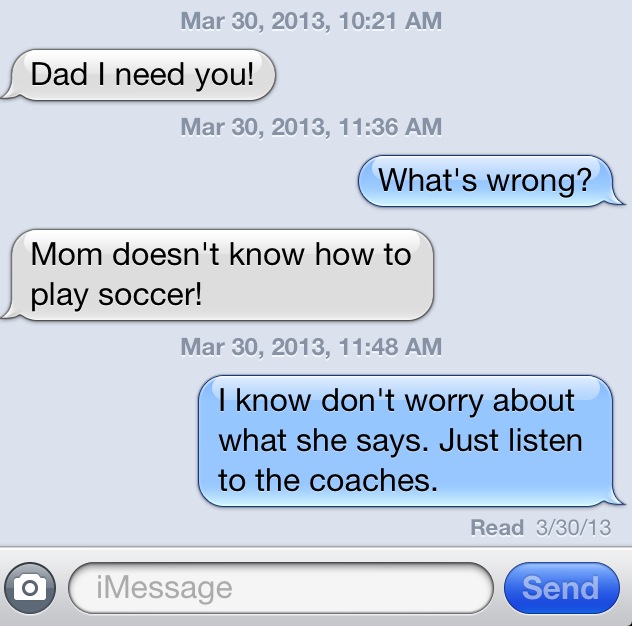
I know for a fact that my career has suffered because I am not able to put in the kind of hours that I need to move ahead.  When Megan needs to crank hours she works weekends when I am able to cover.  In my role, and most others, to succeed you most often need to be on-site, not only getting stuff done, but selling the fact that you get it done.  That takes hours.  When a spouse has a partner that covers all non-work activity so that he/she is able to focus on work, that inevitably will lead to success.  This works both ways.  I have chosen not to be an absentee father during the week for several reasons.  Primary is the fact that as much as the girls make me crazy, I still want to be an integral part of their lives.  It is painful to me when I sense that they are NOT getting my fatherly perspective on things.  My favorite text exchange with Taylor exemplifies that point.

photo (3)

Tay relies on me for certain perspective that Megan can’t give.  That is a good thing and I am happiest when I see that she really wants me to be part of her world.  Haley needs the structure and the consistency that is much better delivered from me than Meg.  There are areas in which I excel and areas in which Megan is FAR superior.  Fathers should want to be more involved with their kids’ lives.  But the real benefit to society is when both partners find a way to support each other and agree to mutual career success.

But I will not let the women off the hook so easily.  The “mutual” part means that you agree on a parenting strategy and then execute against it.  If you come to agreement, you have to trust the other to execute even when you are not there with the same sense of intensity from both parents.  Oh and by the way, the ‘agreement’ part is on the SAME strategy.  How often do the ‘experts’ say that consistency is the most important part of being a successful parent?  Parental trust has to be more than token expressions and then overt complaints when you disagree with an approach.  That violates the very nature of a partnership.  I would argue that fathers (in two parent households) that decide to spend time at work, very often do so because they are not allowed to participate at home.  Women have to acknowledge that there is a certain ego in the notion of “motherhood” that automatically assumes a superiority of skill in all things parenting.  This is not the case.  Juxtapose this notion against the prevailing attitude in the workplace that ‘men are tougher and thus better managers’.  If that assumption is outrageous, then mothers as ‘better parents’ is just as obnoxious.

Clearly there is fault all around, but I argue that inequality in the workplace is an unintended consequence of inequality in the home.   Or vice versa, I really don’t care which came first.  I know you want to yell at me right now, but before you do, just think about it for a second.  Is there even a possibility that this might be true?  And if you are female and just dismissed my comments outright, thus subscribing to the notion of absolute superiority of mothers, didn’t you just make my point?  If you are male and repulsed by the notion that for your wife to achieve equal success that you might have to do your share of work around the house (including dishes, dinner, laundry, cleaning, diapers, soccer duty, etc) then don’t complain about feminists who are frustrated by earning 80% of your salary.  Come on, think about that for a second.  Still naïve?

Posted in Uncategorized | Leave a comment

A Good Start

What do you call 500 lawyers at the bottom of the ocean?   A good start.

I am a fan of the law and the Supreme Court in particular, but I still hate what many lawyers have done to over complicate the law and regulations in particular.  2100 page Obamacare?  800 page Immigration reform?  2300 page Financial reform?  Laws that are “of the people by the people for the people” should be simple enough that you don’t always need a lawyer to understand them.

I read a story the other day that Blackrock, the world’s largest money manager and one of the largest creators of ETFs had laid off 300 employees in March.  This is a result of a cost saving reorganization plan put in place last year.  On May 3, the CEO announced that the company will hire 300 lawyers to help it cope with global banking regulations.

We criticize CEO pay and management ineffectiveness, but here is a company that manages huge amounts of our pension and retirement assets, trying to safeguard our financial future by providing specific products that were created with very low costs (ETFs), to protect our returms.  They came up with a plan to save money further, which may in turn have led to even lower fees as downward pricing pressure has effected management fee bps across the industry.  The 300 were most likely lower level associates that got pink slips, you think they make as much as 300 corporate lawyers?  Don’t I have to conclude that in this case government regulations are widening the income gap?

What did they realize after years of trying to figure out what is going on?  That banking regulation across all of the world’s monetary systems has become so complex that the largest holder of banking debt/equity needs to hire an additional 300 full time lawyers over the course of 2013 just to address the regulatory mess.  Some of that mess results from laws passed whose regulations have not even been written.  Basically companies are playing a game in which the rules for how to play are in flux.  Imagine moving your rook across a chessboard only to find that the rules have changed and you can no longer move it backward.  As you evaluate your next move, how do you consider acting when you know there will be more rules changes?  When you see that so many corporations have cash sitting on the sideline and are too afraid to hire and invest, do you really think Elizabeth Warren, Barney Frank, Chris Dodd and the rest of the regulatory rules making committees really had our best intentions in mind?

Four years after the financial collapse, the market has returned to pre-crisis levels.  But hiring and investment has not.  I wonder if we could put a price tag on the lack of economic development, growth, tax revenue, personal income, etc that has been caused by the slow economic recovery over the past few years.  It is uncharacteristically slow for a ‘recovery’ and is undoubtedly partially caused by uncertainty in the market with businesses not investing.  I’d like to compare that ‘cost’ to the macroeconomic cost of what another 9 month financial crisis price tag would be and then ask people if they really want to spend all this time living in stagnation so that lawyers can try to legislate and regulate for a crisis we can’t really conceptualize.

If I asked you if you would want to endure years of construction and $millions of cost trying to build a strong enough roof over your yard so you could go out and enjoy the fresh air without having the risk of being killed by a meteorite, would you say “yes”?  Oh and that super fancy roof will do nothing to protect from flash floods, gangbanger drive-by’s, hurricanes or other natural disasters.  You still want to buy shares in this here Brooklyn Bridge?

There’s a reason they call it “risk” folks, get out there and take some.  Oh and be sure to tell every political lawyer you see to go take a swim in the Atlantic.

Posted in Uncategorized | Leave a comment

Terrorism

Marathon Monday is a tradition.  This was the first year in 5 that I was not with Loren at the Sox game followed by cheering the runners on Boylston.  It was strange to see pictures of the gang and I wasn’t there.  This isn’t some conspiracy rant on my part and I don’t have regrets or feel any karma, it just feels strange to have not been in Boston with Loren, Ryan and Shannon.

The simple story is that we go on vacation next week and I couldn’t burn the extra day of vacation.  But throughout the day I was texting with friends along the route, and watching the progress of runners on the BAA site.

I have never run Boston, though I would love to.  The fact is I am not that fast and couldn’t qualify.  I could run for a charity, but even that is hard to do nowadays.  Most don’t realize but getting a number for Boston is actually pretty hard.  I’ve stood along the route watching the runners pass, seeing the looks on their faces as they approach the finish line.  I never really understood that joy until I ran some longer races and you hear people call your number, cheer you on, and ring cowbells (it’s true, you can never have too much cowbell).  The atmosphere is electric.  I’ve run smaller races so there are long stretches where you don’t see anyone.  I can only dream of what coming out of Hopkinton is really like or that final stretch as you pass Fenway.

I don’t really have any profound thoughts about the day, just sadness for the families, anger at the perpetrators and disappointment that such a vaunted institution is now stained.  I did hear something interesting this morning on a radio program.  The DJ said that ‘the terrorists have got it all wrong, every time they attack, we become more resolved.’  There is a lot of meaningless chatter out there right now, but that struck a chord.  I also heard the crowd cheer throughout the national anthem at the Blackhawks game, that was pretty powerful.

I would like to add a little of my own commentary on the notion of terrorism.  Today the President called it a terrorist attack, but yesterday it was not and that really bothered me.  Two hours after the event, it was pretty clear that this was not an accident.  If someone or some group aims to indiscriminately hurt, maim, kill or instill fear in people through violence, that is terrorism.  Political motivations are not needed to justify the word.  If you try to harm innocent, unrelated, unaffiliated people you are a terrorist.  A bully in the playground is aiming at one or a few specific people, that is not terrorism.  Murder and other violent crimes, is not, because there is a separate intent, either at one person, or an intent to do/ get something.  Acts of violence at an abortion clinic are targeted at anyone, and the intent is to scare people from going there.  That is terrorism.  A gang-banger who shoots blindly into a house on a drive by is a terrorist.  His intent is to instill fear.  All the other classic terrorist actions are still included, my intent is to help define the word, not spell out every single use case.

Best wishes for the victims and their families

Posted in Uncategorized | Leave a comment

Drop the God Complex

Some people quote poets, some great books, others quote politicians.  I am not that well read, so I quote movies.  If you have never seen the movie Malice with Alec Baldwin and Nicole Kidman, well you aren’t missing much.  But I happen to love this scene, where Baldwin’s character, a brilliant surgeon, tells the lawyer suing him for malpractice, that in the operating room…”I am God.”

Unfortunately, I think God Complex syndrome might be contagious within the ranks of religious conservatives.  Bob Portman came out in favor of gay marriage the other day, and the Supreme Court just heard oral arguments.  But regardless of what they all do, I have had this post in my head for a while now.  And for the record, I didn’t come to this realization because of them or because I have gay family members…all of that is a copout.  I like to think this is a rational analysis of a question, the second I have tried for a social issue.  We’ll see how it goes.

So as you might guess, I wasn’t going to just rely exclusively on some web site for background, I decided to go to the texts.  I didn’t read the whole thing, but here is what I found in my copy of the Bible that was given to me for my confirmation on May 20, 1988.  No I don’t remember the day, it is signed by Suzanne Paley.  Page 6, Genesis 2.24 after God creates woman “Hence a man leaves his father and mother and clings to his wife, so that they become one flesh.”  The Book of Mormon starts much later, with the First Book of Nephi, so there is no equivalent to Creation.  Yes I have a copy, drives Megan crazy, but I always talk to those guys when they walk through the neighborhood.  The Jehovah’s Witnesses’ Watchtower has the same line on page 9, with a slightly different translation.  Yep, have one of those too.

I have read and heard that the big problem is with the word “marriage”.  Religious conservatives say that a marriage is between one man and one woman for the basis of procreation.  I am not sure that argument holds, since Adam and Eve “became one” before they had eaten the apple.  In that case, God created Eve because no “fitting helper” could be found among all of the animals that were brought before Adam to name.  Therefore, the family unit wasn’t even considered.

Getting married for the sake of a family doesn’t make sense either; what if a woman has passed menopause?  What if a couple decides not to have kids?  What if one party is sterile?  I have heard arguments in the reverse that kids are best served in childhood by a mother and a father in one house.  The notion of love is secondary.  What of an abusive father?  What if the couple neglects the child?  Would we turn to Brave New World style childbirth permitting?

I go back to the notion of “marriage” as a religious institution and a contract between a man, woman and God.  I am fine with that as a definition of marriage in the Judeo-Christian classical sense.  But if that is the case, then the Court should strike down the ability of the government to certify a contract with God as a breach of the separation of church and state.  In that case, the state is allowed to grant civil unions and that only.  This institution should be between any two adults who wish to form a legal union based on mutual affection (I reserve the use of the word “love”).  Spousal and all other legal rights formerly known under the institution of “marriage” should be conveyed on the couple.  Clearly we grandfather all existing marriages under the institution of “civil union”, although the wedding industry would surely love it if we all had to do it over again.

If a religion wants to grant a civil union as the legal component of its definition of “marriage”, the state can deputize those religious organizations to that responsibility.  Catholicism may decide that a “marriage” is only between a man and a woman, but some other religion may choose to define “marriage” differently.  A freak religion could even grant “marriage” or any other word as between any two parties (say between a man and a muscle car), but that would not then be afforded the rights of a “civil union” as legally defined by the government.   We allow beliefs in any craziness, so long as it doesn’t supersede legal authority or harm others.

My intent here is not to make some big deal about what “marriage” is or is not.  In my opinion, the time spent writing this post is already wasted from a civics perspective, because we have WAY bigger problems than this.  Therefore, I say it is rational to recognize a public notion of an adult two person union that needs legal benefits while at the same time there is a private religious notion of a union that is based on something different.  I have heard people argue that we must protect the institution of marriage as a sacred bond.  That’s fine with me if people want to think that way in their own private world of religious piousness.  A violation of that commandment (if it even is one) doesn’t hurt other people similar to the fact that violations of the laws of keeping Kosher, doesn’t hurt other people.  In these cases, there is no reason to think that you are so important that you MUST enforce these laws on others.  I worship God and my relationship is with him, not you.  Do people that feel this way really think that the all-powerful and omnipotent God needs help in enforcing his law?  Why would someone deputize themselves with some sort of God-complex, that they need to impart their (God’s) will on everyone?

Remember the biblical story of Sodom and Gomorrah?  When God sent Abraham into the lawlessness, he said he would save the cities if even just ten righteous people could be found.  So all we need to do is make sure we are represented before God by these righteous religious followers, ten per town.  Lucky for us, their sheer presence will save us from God’s wrath and certain destruction.  In the mean time, if a gay couple chooses to violate one of God’s laws in a way that doesn’t hurt anyone else, I tend to think that if God is really bothered, he can pretty easily destroy them on the spot.  If he chooses to deal with it later, well then rest assured, all you pious zealots can say “I told you so” from heaven while all of the “sinners” rot in hell.  There, you win.  Now can we get back to debating important stuff?

Posted in Uncategorized | Leave a comment